OUR HISTORY
60 YEARS OF HISTORY
The cable car that takes you above the lake
The Laveno Mombello cable car takes around 15 minutes to travel from the centre of Laveno to the summit of Mount Sasso del Ferro, reaching the spot known as ‘Pizzo dell’Orsera’ – incorrectly referred to as ‘Poggio S. Elsa’ – which takes its name from the wife of the first builder, an entrepreneur from Legnano.
From this vantage point, one can enjoy a breathtaking view of the lakes of the province of Varese, and in particular of Lake Maggiore. The idea for a ski lift came from Mr Mario Bianchi, whilst construction work began in 1960, following the acquisition of the necessary land, which involved a significant donation from the Terruggia family, who ceded their land for the symbolic sum of one lira and were granted – though this privilege was never honoured – perpetual access to the ski lift. Further land was made available by the local council and private individuals.
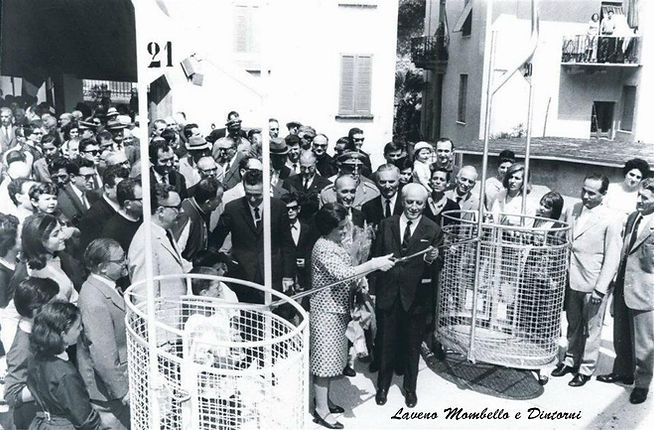
The first lift was built by Telemeccanica Atesina on behalf of a group of shareholders at the time; it was later overhauled by Panzeri of Milan, which replaced the passenger gondolas. The lift was inaugurated in the spring of 1963, on 24 April.
In 1965, it was taken over by the company Rossi & Mattioni of Gemonio (Paolo Rossi and Giampaolo Mattioni). During those years, Mattioni himself opened the small ski area on Sasso del Ferro, comprising a cable car and a ski lift, where the provincial ‘Youth Games’ were held in 1974.
The ski lift, built by Leitner, was called “Giove” and, starting from “Poggio Sant’Elsa” at an altitude of 1,000 metres, it reached the summit of Mount Sasso del Ferro at 1,062 metres above sea level. A powerful “snow cannon” was also put into operation. This tiny ski resort remained in operation until the early 1980s, when, due to scarce snowfall and the low altitude – which, because of the temperatures, prevented the use of the snow cannon – it closed its doors. The ruins of the ski lift and the chairlift are still visible at the summit. Since the 1960s, the top station has become dotted with television, radio and service masts, given its strategic and geographical importance as a ‘bridge’ between various communication and transmission networks. The row of small cabins, originally painted yellow but now more in keeping with the surroundings, has been repainted green following the complete modernisation of the lift – which first came into operation in the spring of 1963 – carried out in two successive phases.
With its 50 years of ‘tourist and sporting service’, the Sasso del Ferro Cable Car is, in the memories of the people of Laveno, a fixture that has long been part of the landscape of the stunning and picturesque Gulf of Laveno.
A tourist destination attracting a large number of foreign visitors, it is also a popular spot for school trips and/or youth club outings, groups of senior citizens, as well as tours led by tour operators. This makes it part of a trio of highly popular tourist itineraries, including the Hermitage of Santa Caterina, the Borromean Islands and the panoramic view of Lake Maggiore from Sasso del Ferro, whose slopes drop vertiginously down towards the gulf and the lake. But even when strolling up and down the lakeside promenade in Laveno (the ‘vasche’), amidst the comings and goings of ferries and boats on the lake, it is lovely to look up and see the sky dotted with the colourful sails of paragliders and hang-gliders, as well as the constant movement of the cable car gondolas carrying tourists to the summit.
It was on this summit that the Laveno-born actor Renato Pozzetto set the filming of the movie *Il Volatore di Aquiloni* or *Milano nel Mondo*. It is since 1975 that Laveno Mombello, thanks to the ‘Funivia’, has become the European home of free flight. Drawing on this sporting and tourist heritage, one of the owners, Gianpaolo Mattioni, coined the saying ‘La… where eagles dare’. Ten years ago, as the cable car marked its fortieth anniversary, the facility reached the end of its normal operational life. Given the difficulties faced by the Mattioni & Rossi ownership in financing timely and regular maintenance, rumours began to circulate about a possible closure of the cable car. The Pro Loco of Laveno Mombello immediately sprang into action, collecting thousands of signatures to save the cable car, given that it carried an average of 50,000 tourists each year, from spring to autumn, the majority of whom were foreign visitors. It was, therefore, a major driver of tourism and the local economy. The first to respond to the heartfelt appeal from business owners, shopkeepers and the local population was the Province of Varese itself, followed by the Municipality of Laveno Mombello (Mayor Sergio Trezzi) and the Valcuvia Mountain Community.
The Lombardy Region itself, just as the closure of the lifts seemed imminent, realised that a tourist attraction and a piece of local history and tradition would be lost, and stepped in with its own funding.
In November 2003, the Società Funivie del Lago Maggiore, thanks to a grant of 25,000 euros allocated by the Province of Varese, succeeded in winning the regional tender for the ‘Granting of subsidies and measures for technical innovation, modernisation and the improvement of safety standards in cableway systems’. An extension to the closure date was granted until 26 September 2005, a period sufficient to refurbish the installation. However, further funds were required to complete the works: whilst the €775,278 from the regional tender provided the initial funding to carry out the necessary works. Subsequent electromechanical work on the main system, structural restoration and adaptation work, various related construction works and technical assessments caused the budget to rise to 2,232,965 euros. To this end, the Municipality of Laveno Mombello and the Valcuvia Mountain Community contributed 500,000 euros, whilst the Province of Varese provided a further 1,290,319 euros, part of which was raised by cutting the allowances of its administrators, following a decision by the then president, Marco Reguzzoni; this finally made it possible to bring the project to a successful conclusion.
The works, which began on 22 December 2004, were completed on 25 January 2006. The construction of the new cable car system was entrusted to the company CCM Finotello, which, whilst retaining the lower and upper stations, replaced all the supporting pylons with polygonal shafts, also demolishing the characteristic reinforced concrete pylon at the front of the upper station, as well as, of course, replacing the cables. With the official opening on 31 March – attended by the President of the Province, Marco Reguzzoni, almost the entire provincial council and local authorities – the Lake Maggiore Cable Car was permanently reopened to the public.
In 2025/2026, the Mattioni and Rossi families repurchased the cable car and invested over 700,000 euros in a further round of major maintenance work, aimed at the complete refurbishment of the facility.
The new Lake Maggiore Cable Car, now well managed by these families, remains a flagship attraction for tourism on the Lombardy side of Lake Verbano. In addition to enhanced safety standards, the cable car, with its 731-metre vertical rise, offers a unique and picturesque view of the Pre-Alps.
The new cabins are slightly larger than the previous ones and can accommodate two people. There are 53 open cabins and, another new feature, 27 enclosed cabins, the number of which increases during the winter season, making the journey considerably more comfortable and thus ensuring service all year round. The lift has an hourly capacity of 284 people. Once you arrive at the terrace known as ‘Poggio S. Elsa’, you can enjoy a 360-degree panorama: from the plain, with its villages where cars look as small as toys, right up to the unmistakable Monte Rosa massif, perfect and majestic. And then there are the lakes, set against a breathtaking backdrop of the often snow-capped Swiss mountains. On clear, slightly windy days, with a telescope you can make out not only Malpensa but also the spires of Milan Cathedral on the horizon. In summer, when the sun is out, the balcony and the surrounding meadows become a natural sunbathing area, where you can watch hang-gliders and paragliders take off. The cable car’s top station also offers all the necessary amenities: the bar, which serves cold dishes and sandwiches, whilst the restaurant, with its splendid view of the lake, offers tasty culinary specialities and a catering service for banquets, weddings or parties.
This is also thanks to a large panoramic terrace, which can be covered if required. For those wishing to spend a night under the stars, accommodation is available at the Albergo Ristorante Funivia, with its 18 three-star rooms; in the evening, you can enjoy an enchanting and unique night-time spectacle of the Varese lakes. If you fancy stretching your legs without too much effort, you can walk down to the village of Casere in under 20 minutes along a mule track that’s steep only on the first stretch. Here you’ll find ‘La Gigliola’, a restaurant renowned for its rustic cuisine, and not far away, towards Vararo, it’s well worth stopping off at the Capra e Cavoli Farm, where you can buy excellent goat’s cheeses, including the speciality ‘Baci di Vararo’, a raw-milk goat’s cheese. You can then choose to return to Laveno by heading back up to the cable car station; or, if you fancy a walk, you can descend on foot along the yellow-green marked footpath (the Anulare Valcuviano) through deciduous woodland to the hamlet of Monteggia.
There are several mountain trails leading off from the summit, offering opportunities for mountain trekking and mountain biking; for the latter, you can take the cable car up to the summit at ‘Poggio S. Elsa’.
However, for those tackling the mountain trails, our Laveno Civil Protection team advises wearing suitable kit; given the presence of rugged and dangerous areas, the Laveno Mombello Civil Protection service recommends that you never stray from the main trails.